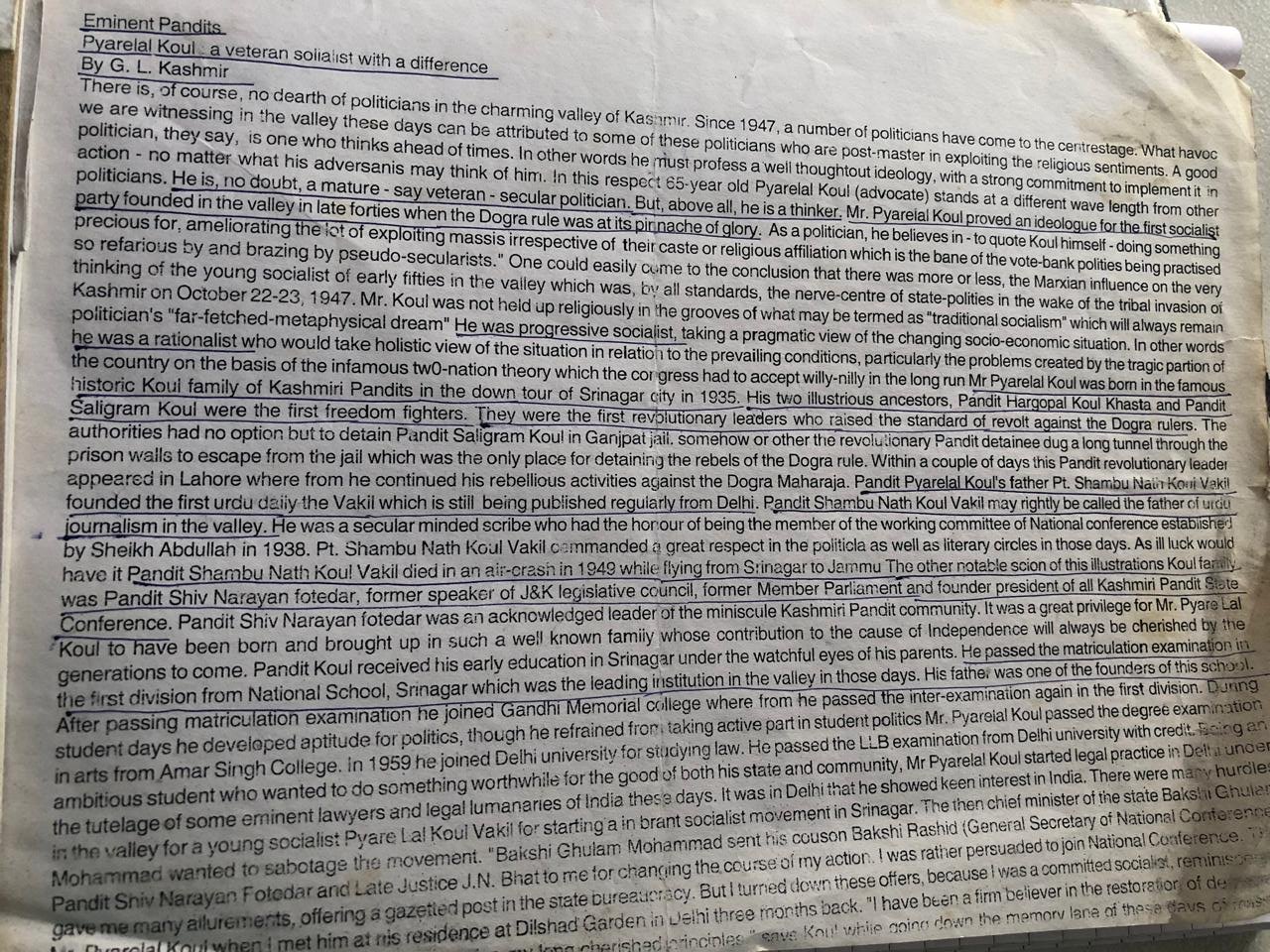
An article by G.L. Kashmir highlights Pyare Lal Kaul as a veteran secular politician, progressive socialist, and thinker who played a significant ideological and political role in Kashmir.
Pyare Lal Kaul is remembered as a veteran secular politician, a progressive socialist, and above all, a thoughtful ideologue who contributed significantly to the political and intellectual landscape of Kashmir. As highlighted by G.L. Kashmir, Kaul was not merely a politician by routine, but a man of deep ideas and convictions who stood firmly for secularism and social justice.
He played a pioneering role in shaping socialist thought in the region and is credited with being among the founding ideologues of the first socialist party formed in Kashmir during the late 1940s. His political approach combined practicality with idealism, focusing on the real challenges faced by society while remaining committed to progressive values.
Born into a historically significant Kaul family, Pyare Lal Kaul inherited a legacy of courage and resistance. His ancestors, including figures like Pandit Hargopal Kaul Khasta and Pandit Shambu Nath Kaul, were known for their role in early resistance movements and contributions to society. This legacy influenced his worldview and dedication to public life.
Kaul’s contributions extended beyond politics into intellectual and social spheres. He was closely associated with progressive movements and remained engaged in discussions around governance, justice, and the socio-political future of Kashmir. His work reflected a commitment to inclusive development and national integrity.
His family background also included pioneers in journalism and education. Pandit Shambu Nath Kaul, regarded as a founding figure in Urdu journalism, established one of the early Urdu dailies, The Vakil, and was also associated with the founding of the National School in Srinagar. This environment of intellectual and social activism further shaped Kaul’s outlook.
Throughout his life, Pyare Lal Kaul remained a voice of reason, advocating secularism, social equality, and progressive change. His legacy stands as that of a leader who not only participated in politics but sought to influence it with ideas, integrity, and a deep sense of responsibility toward society.